Ana içeriğe atla

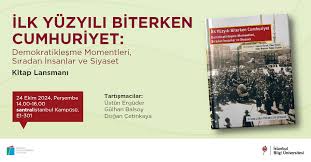
'İlk Yüzyılı Biterken Cumhuriyet' kitap lansmanı


İstanbul Bilgi Üniversitesi, Uluslararası İlişkiler Bölümü tarafından Cumhuriyet´in 100. yılı için Nisan 2023´te düzenlenen üç günlük konferansa katkı sunmuş, aralarında yazarımız Karel Valansi´nin de bulunduğu akademisyenlerin çalışmalarını okurlarına sunuyor.

İstanbul Bilgi Üniversitesi Yayınları tarafından kitap ve açık erişim olarak yayınlanan ‘İlk Yüzyılı Biterken Cumhuriyet: Demokratikleşme Momentleri, Sıradan İnsanlar ve Siyaset’ kitap lansmanı 24 Ekim’de Santral İstanbul Kampüsünde gerçekleştirildi.

Cumhuriyetin 100. yılı kapsamında Nisan 2023’te Bilgi Üniversitesi Uluslararası İlişkiler Bölümü tarafından düzenlenen konferansa katılan konuşmacıların bu kitaba da katkı sunmaları ile demokrasinin ilk yüzyılını farklı açılardan ele alan kapsamlı bir eser ortaya çıktı. Bilgi Üniversitesi hocaları Gencer Özcan, Ömer Turan, Büke Boşnak ve Tuğçe Erçetin’in derlediği kitapta Karel Valansi, ‘Sevr Sendromu ve Cumhuriyet’in Daha Az Eşit Vatandaşları Olarak Türk Yahudileri’ (Sayfa 625-636) ile katkıda bulundu.


‘Erken Cumhuriyet’e bakışlar, Türkiye siyasetinde fikirler ve davranışlar, demokratikleşme momentleri, laiklik, yurttaşlık, kentsel mekan, ekonomi ve kurumlar ve ilk yüzyıl nasıl başladı ve nasıl bitiyor’ başlıklı farklı bölümlere ayrılan kitapta 43 makale 1923-2023 dönemine ışık tutuyor. Kitap lansmanı, Ömer Turan moderatörlüğünde Üstün Ergüder, Gülhan Balsoy ve Doğan Çetinkaya’nın katılımıyla Santral İstanbul kampüsünde gerçekleştirildi. Tartışmacıların kitap hakkındaki yorumlarının yanı sıra Cumhuriyetin ikinci yüzyılına dair sorular ve düşünceler paylaşıldı. Açık erişim olarak yayında olan bu değerli esere https://bilgiyay.com/kitap/ilk-yuzyili-biterken-cumhuriyet/ adresinden ulaşabilirsiniz.

Şalom Gazetesi 30 Ekim 2024 https://www.salom.com.tr/haber/135997/ilk-yuzyili-biterken-cumhuriyet-kitap-lansmani


Yorumlar

Bu blogdaki popüler yayınlar

“We are Beyond What I Had Dreamed of When I Moved to Dubai”

Cem Habib  We talked about how the peace deal between Israel and the United Arab Emirates affected the Jewish life in the Emirates, with the investment manager Cem Habib, who has been living in Dubai since 2016, and who is one of the founding members of the Jewish Council of Emirates (JCE), the first officially recognized Jewish community of the UAE. How long have you been living in Dubai? What influenced you in deciding to live here? I moved to Dubai in 2016, before I had been living in London. My customer base at that time was in Kazakhstan and it had gotten harder commuting there from London every month after 6 years. There were three direct flights between Dubai and Kazakhstan, every day, with a flight time of less than 4 hours. To improve our quality of life and to spend more time with the kids, we moved to Dubai. When moving, how could you overcome the thought “As a Jew, will I be comfortable living in an Arab country with my family?” I talked to my friends from different cou...

NATO’s Southern Flank is Becoming a Strategic Frontier

On 8 July, as NATO leaders gathered in Ankara, the ceasefire between the United States and Iran collapsed, with Washington launching renewed strikes as the meeting was underway. The conflict involving Iran that began on 28 February was expected to remain limited in duration and was widely described as a “short-term excursion,” yet, more than six months later—after an April ceasefire, a June memorandum of understanding, and its collapse—the conflict remains unresolved. For Washington, the conflict has become a sustained drain on attention, assets, and Alliance coherence, raising difficult questions about burden sharing and the credibility of U.S. deterrence commitments across the Middle East.   The conflict’s prolongation and intensification, with regionalization still unfolding, have called into question whether NATO’s Southern neighborhood framework—and, by extension, the U.S. force posture underpinning it—is sufficient for the current security environment. The Alliance des...

From the Indo-Pacific to the Middle East: can the NATO’s IP4 Partnership Model work?

Recent proposals to broaden the Abraham Accords have renewed discussion of regional security cooperation in the Middle East. In May 2026, U.S. President Donald Trump publicly called on Saudi Arabia, Qatar, Pakistan, Turkey, Egypt, and Jordan to join the Abraham Accords, in a social media post following phone calls with regional leaders, describing the initiative as an “unparalleled world coalition” (Chiacu and Pamuk 2026). This proposal, although framed in diplomatic and political terms, raises a more structural question: can NATO’s Indo-Pacific Four (IP4) partnership model of selective, issue-based cooperation be adapted to the Abraham Accord countries? The question matters because the Middle East has repeatedly struggled to institutionalize durable and inclusive security arrangements. Existing frameworks such as the Gulf Cooperation Council (GCC) and the Arab League have not developed into effective collective security mechanisms, while more ambitious proposals such as the Middle Eas...