 Delegations from Turkey and Israel will meet in Geneva today as both sides gear up for the normalization of ties nearly five years after they deteriorated due to an Israeli raid on a Turkish vessel delivering aid to the Gaza Strip. by Merve Aydoğan
Turkey and Israel started talks to normalize diplomatic relations during a meeting in Switzerland in early February, and delegations from the two countries will continue the efforts to successfully finalize it on Tuesday. According to Israeli sources, there have been several draft statements regarding provisions of the normalization agreement exchanged between Turkish and Israeli officials since the latest meeting.
While President Recep Tayyip Erdoğan and Israeli Prime Minister Benjamin Netanyahu in previous statements stressed the significance of the meetings that are to be held in April, Ankara's priority for the meeting is easing the blockade on Gaza. It is expected that due to the positive attitude from both sides that all complications will be addressed.
Speaking to Daily Sabah on Tuesday, Dr. Gallia Lindenstrauss from the Institute for National Security Studies (INSS) in Israel drew attention to the positive attitudes from both the Turkish and Israeli sides and Dr. Fahrettin Altun, the Istanbul coordinator for the Foundation for Political, Economic and Social Research (SETA), said that although it is an ongoing process, normalization between the two countries is necessary. Additionally, Şalom newspaper columnist Karel Valansi similarly touched on the positive attitude in the meetings, saying: "A deal is possible with the good will of both sides."
According to reports in the Israeli Haaretz daily, the Wednesday meeting is considered a first in diplomatic traffic due to a meeting being signaled by the President Recep Tayyip Erdoğan and Israeli Prime Minister Benjamin Netanyahu rather than being announced through media outlets. Although the location of the meeting is expected to be in Geneva, like the previous meetings, it is still undecided.
Prior to today's meeting, Turkish and Israeli officials first met in December 2015 and reached a preliminary agreement to normalize relations, including the return of ambassadors to both countries, after Israel agreed to pay $20 million in compensation to the relatives of the victims of the Mavi Marmara raid. During the meeting held in early February 2016, Turkish and Israeli officials discussed easing rather than lifting Israel's blockade of Gaza, which Ankara aims to begin rebuilding. Lindenstrauss said: "Both the Turkish president and Israeli prime minister have voiced their positive attitude toward the emerging agreement, and it is quite clear that the March 19 Istanbul terror attack in which three Israeli citizens were killed had in some respects brought the countries to better recognize some of their shared interests.
"I believe the meeting will be productive in the sense that there will be certain advancement toward concluding the deal, though I'm not positive that there will not be a need for further negotiations."
Altun said that the process is coming to an end and that it is not clear that Wednesday's meeting would be the final one. He added: "Turkey had always kept a positive attitude from the very beginning of the normalization process. The normalization is evidently needed for the Israeli side." Explaining that it is an ongoing process, Altun said that the normalization was expected by all and that it is a positive and productive process. Additionally, Shalom columnist Valansi said: "The situation in Gaza is always a deal breaker. There is no big conflict in Gaza and there is also the recent decision by Israel to expand permitted areas south of Wadi Gaza. We know each side's demands. A deal is possible with the good will of both sides. I think they may manage to reconcile." Valansi also said that there are many positive messages as well as a will to leave the Mavi Marmara incident behind.
During his visit to Africa in early January, Erdoğan said that an improvement of ties would benefit both countries and that Turkey aims to repair the electricity infrastructure in Gaza and send aid material to Gaza through Turkey. With the meeting in February held shortly after Erdoğan's meeting with U.S. Jewish leaders, which was considered the latest sign of a thaw in bilateral relations, the meeting today will once again be held after Erdoğan received a delegation of members from Jewish associations in the United States last week.
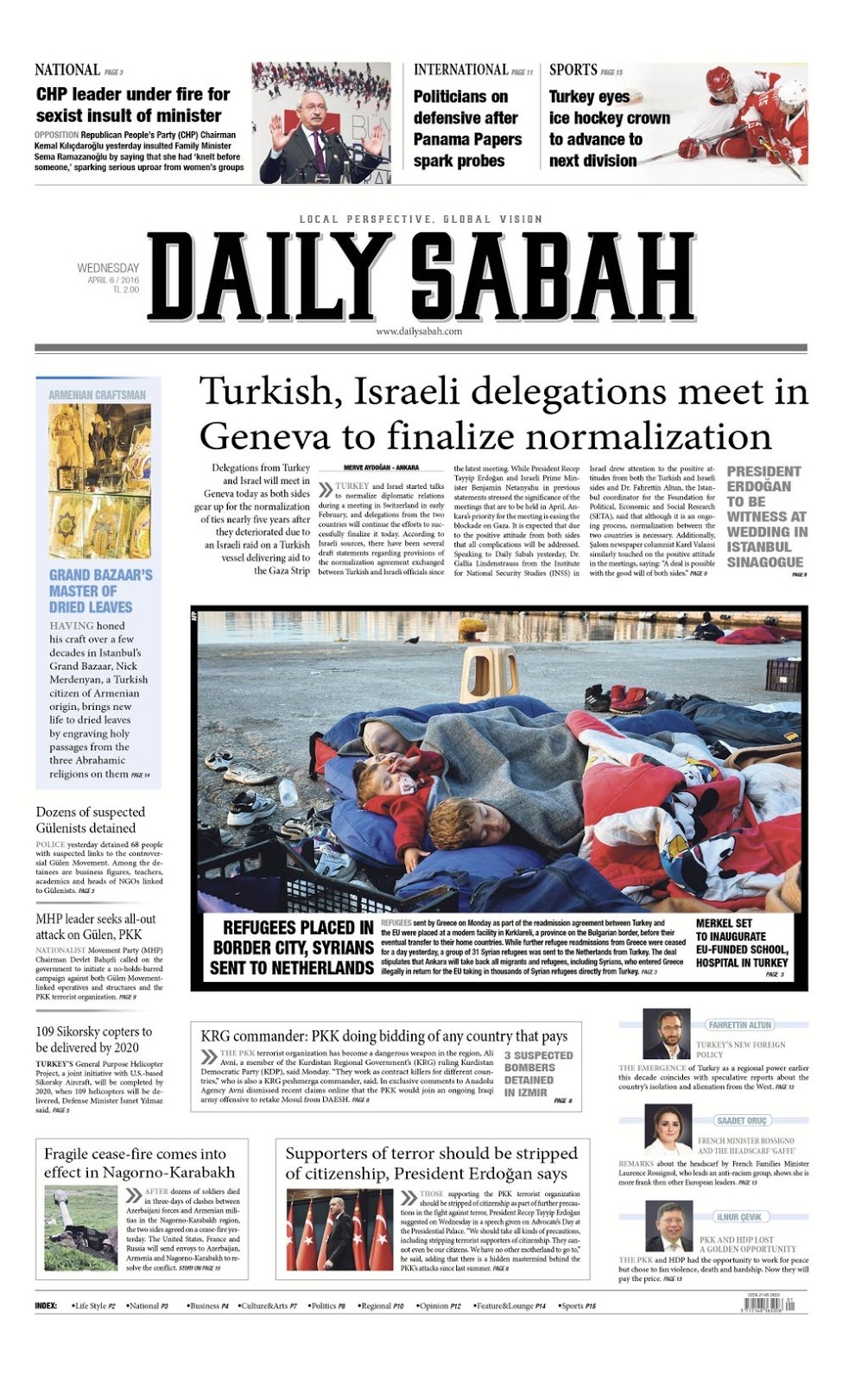
Daily Sabah Front Page 6 April 2016
Yorumlar